






















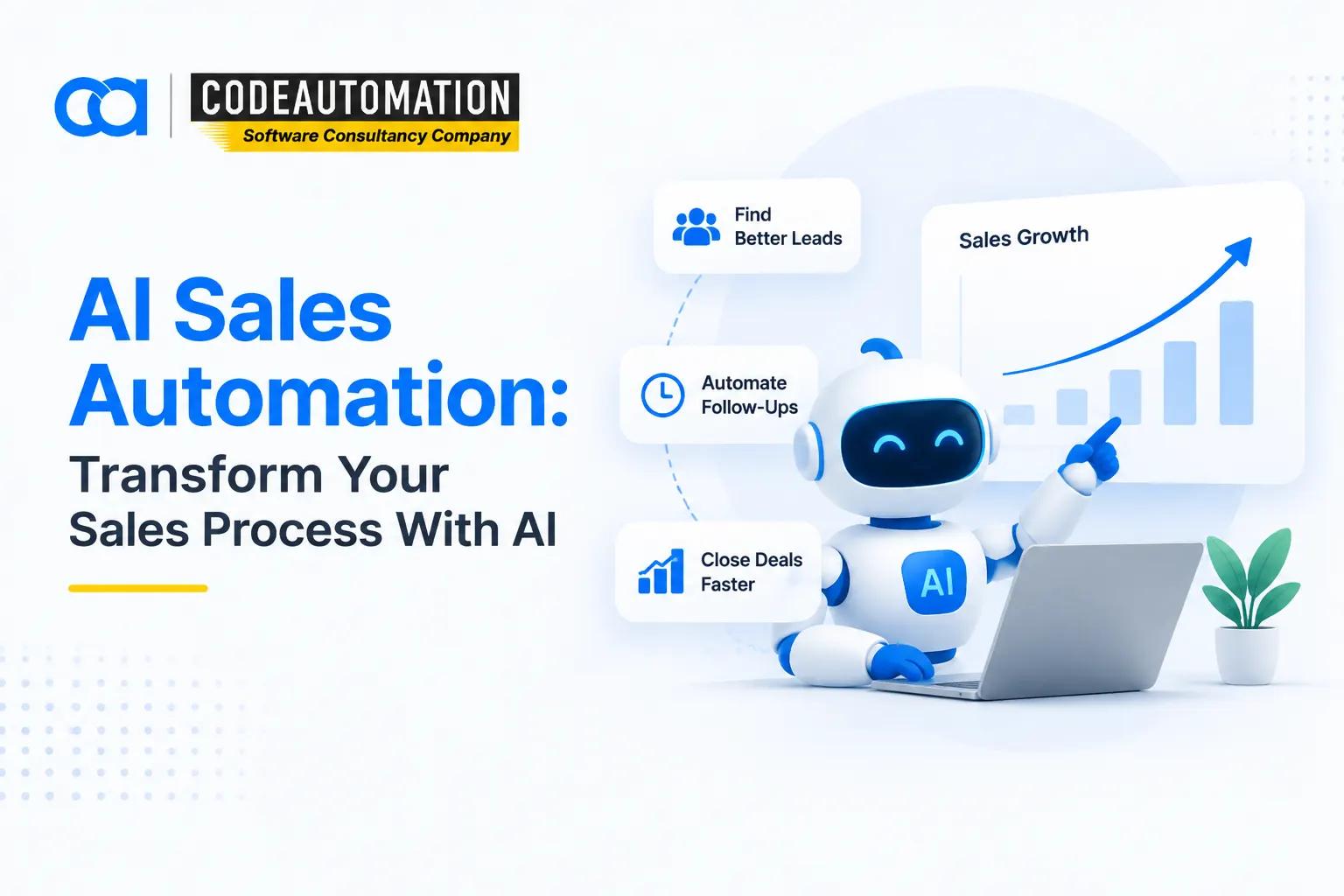
AI Sales Automation Transform Your Sales Process With AI
Published 15/09/2026
Sales teams spend a significant amount of time managing repetitive tasks instead of focusing on what matters most: building relationships and closing deals. Activities such as researching prospects, updating CRM records, sending follow-up emails, analyzing sales pipelines, and preparing reports consume valuable hours every week.

Ready to Automate Your Success?
From AI-powered applications to scalable software development, we help businesses automate workflows and accelerate growth.
Book a Free ConsultationSales teams spend a significant amount of time managing repetitive tasks instead of focusing on what matters most: building relationships and closing deals.
Activities such as researching prospects, updating CRM records, sending follow-up emails, analyzing sales pipelines, and preparing reports consume valuable hours every week.
AI sales automation is changing how modern sales teams operate by combining artificial intelligence, machine learning, automation workflows, and customer data to streamline sales processes.
Instead of relying only on manual processes or basic automation rules, AI-powered sales systems can analyze customer behavior, identify opportunities, recommend next actions, and automate repetitive tasks.
Businesses are using AI sales automation to improve lead generation, increase sales productivity, shorten sales cycles, and create more personalized customer experiences.
What Is AI Sales Automation?
AI sales automation is the use of artificial intelligence technologies to automate, optimize, and improve different stages of the sales process.
Traditional sales automation follows predefined rules. For example:
- Send an email three days after a customer inquiry
- Create a CRM task after a demo request
- Move a lead to another stage after a specific action
AI sales automation goes further by analyzing data, understanding patterns, and making intelligent decisions.
An AI-powered sales system can:
- Identify high-quality leads
- Predict customer buying behavior
- Generate personalized outreach messages
- Recommend the best time to contact prospects
- Update CRM information automatically
- Forecast sales opportunities
- Assist sales representatives during conversations
The goal is not to replace sales teams but to remove repetitive work so sales professionals can spend more time engaging with customers.
Why Businesses Are Adopting AI Sales Automation
Modern sales teams face several challenges:
- Increasing competition
- Longer sales cycles
- Large volumes of customer data
- Difficulty identifying qualified prospects
- Manual CRM management
- Inconsistent follow-ups
According to many businesses, the biggest challenge is not generating leads but effectively managing and converting them.
AI sales automation helps solve these problems by providing faster insights and automating time-consuming activities.
Key benefits include:
- Higher sales productivity
- Better lead qualification
- Faster customer response times
- More personalized communication
- Improved pipeline visibility
- Accurate sales forecasting
How AI Sales Automation Works
AI sales automation works by combining customer data, artificial intelligence models, and automated workflows.
The process usually involves four major steps.
1. Collecting and Connecting Sales Data
AI requires accurate data to make intelligent decisions.
Sales automation systems collect information from multiple sources, including:
- CRM platforms
- Email communication
- Website interactions
- Customer support conversations
- Marketing platforms
- Previous sales activities
- Purchase history
By connecting different data sources, AI creates a complete view of each customer and prospect.
For example, instead of a salesperson manually checking multiple systems, AI can automatically analyze:
- Previous interactions
- Company information
- Customer interests
- Engagement history
- Buying signals
2. Analyzing Customer Behavior
AI uses machine learning algorithms to identify patterns within sales data.
It can analyze:
- Which leads are most likely to convert
- Which customers require follow-up
- Which communication channels perform best
- Which deals are at risk
For example, an AI system may identify that a prospect who:
- downloaded multiple resources,
- visited pricing pages,
- attended a webinar,
has a higher buying probability compared to a lead with limited engagement.
3. Recommending Actions
AI sales systems can provide recommendations to sales representatives.
Examples:
- Contact this lead today
- Send a product comparison email
- Schedule a follow-up meeting
- Offer a specific solution
- Escalate a customer issue
These recommendations help sales teams make faster and more informed decisions.
4. Automating Sales Workflows
After identifying opportunities, AI can automatically execute workflows.
Examples:
- Sending personalized emails
- Updating CRM records
- Creating sales tasks
- Scheduling meetings
- Generating reports
- Updating customer information
This reduces administrative work and improves sales efficiency.
Key Benefits of AI Sales Automation
1. Increase Sales Productivity
Sales representatives often spend a large percentage of their time on administrative activities.
AI automation reduces manual work by handling tasks such as:
- CRM updates
- Data entry
- Meeting summaries
- Follow-up reminders
- Sales reports
This allows sales teams to focus on conversations, relationship building, and closing opportunities.
2. Improve Lead Qualification
Not every lead has the same potential.
AI-powered lead scoring analyzes customer data to determine which prospects are most valuable.
AI can evaluate:
- Website behavior
- Company details
- Engagement level
- Previous interactions
- Purchase intent
Sales teams can prioritize high-value opportunities instead of spending time on unqualified leads.
3. Create Personalized Customer Outreach
Generic sales messages often receive lower engagement.
AI helps businesses create personalized communication based on customer behavior and preferences.
AI can generate:
- Personalized emails
- Follow-up messages
- Product recommendations
- Sales proposals
For example, instead of sending the same message to every prospect, AI can customize communication based on:
- Industry
- Business challenges
- Previous conversations
- Customer interests
4. Improve Sales Forecasting
Accurate forecasting helps businesses make better decisions.
Traditional forecasting often depends on manual updates and sales representative assumptions.
AI sales forecasting analyzes:
- Historical sales data
- Pipeline activity
- Customer behavior
- Market trends
It helps businesses predict:
- Expected revenue
- Deal probability
- Potential risks
- Sales growth opportunities
5. Reduce Sales Cycle Time
Slow responses can result in lost opportunities.
AI automation helps accelerate sales processes by:
- Responding instantly to inquiries
- Automating follow-ups
- Prioritizing urgent opportunities
- Providing sales recommendations
Faster processes allow businesses to move prospects through the sales funnel more efficiently.
AI Sales Automation Use Cases
AI Lead Generation Automation
Finding and qualifying prospects manually requires significant effort.
AI can help businesses:
- Discover potential customers
- Analyze company information
- Identify buying signals
- Enrich customer profiles
- Prioritize prospects
This helps sales teams focus on leads with higher conversion potential.
AI Sales Assistants
AI sales assistants support representatives by automating everyday sales activities.
Common capabilities include:
- Writing email drafts
- Summarizing meetings
- Creating follow-up tasks
- Answering sales questions
- Preparing customer insights
Sales representatives can use AI assistants as productivity tools throughout the sales process.
AI Sales Agents
AI sales agents represent the next generation of sales automation.
Unlike traditional automation tools, AI agents can independently complete tasks by analyzing information and taking actions.
Examples include:
Prospecting AI Agent
A prospecting agent can:
- Research companies
- Identify potential customers
- Collect relevant information
- Prepare outreach recommendations
Outreach AI Agent
An outreach agent can:
- Create personalized messages
- Schedule follow-ups
- Analyze responses
- Adjust communication strategies
CRM AI Agent
A CRM agent can:
- Update customer records
- Organize sales information
- Detect missing data
- Maintain accurate pipelines
Sales Reporting AI Agent
A reporting agent can:
- Generate sales summaries
- Analyze pipeline performance
- Identify trends
- Provide business insights
AI Sales Automation Across Industries
SaaS Companies
Software companies use AI sales automation for:
- Lead scoring
- Demo scheduling
- Customer onboarding
- Account expansion
AI helps SaaS companies manage large numbers of prospects efficiently.
E-commerce Businesses
Online businesses use AI for:
- Customer recommendations
- Abandoned cart recovery
- Personalized marketing
- Purchase prediction
AI improves customer engagement and increases conversion opportunities.
Financial Services
Financial organizations use AI sales automation for:
- Customer qualification
- Personalized recommendations
- Relationship management
- Compliance workflows
Real Estate
Real estate companies use AI automation for:
- Lead qualification
- Property recommendations
- Customer follow-ups
- Appointment scheduling
AI Sales Automation Tools vs Custom AI Solutions
Businesses can choose between ready-made AI sales tools and custom AI solutions.
AI Sales Automation Tools
Examples include:
- CRM AI features
- Sales engagement platforms
- AI assistants
- Lead generation platforms
Advantages:
- Faster implementation
- Lower initial cost
- Ready-to-use features
Limitations:
- Limited customization
- May not match unique workflows
- Integration restrictions
Custom AI Sales Automation Solutions
Custom AI solutions are built around a company's specific sales processes.
They can integrate with:
- CRM systems
- ERP platforms
- Marketing automation tools
- Internal databases
- Communication platforms
Benefits include:
- Custom workflows
- Better scalability
- Improved automation coverage
- Industry-specific capabilities
For businesses with complex sales processes, custom AI automation can provide better long-term value.
How To Implement AI Sales Automation Successfully
Step 1: Identify Sales Challenges
Before implementing AI, businesses should identify problems they want to solve.
Examples:
- Poor lead conversion
- Slow follow-ups
- Manual reporting
- Incomplete CRM data
Step 2: Prepare Data Infrastructure
AI depends on quality data.
Businesses should ensure:
- Accurate customer records
- Connected systems
- Clean databases
- Proper data management
Step 3: Select the Right AI Approach
Companies should determine whether they need:
- AI tools
- AI assistants
- AI agents
- Custom AI development
The right approach depends on business goals and workflow complexity.
Step 4: Integrate AI With Existing Systems
Successful AI adoption requires integration with existing technology.
Common integrations include:
- Salesforce
- HubSpot
- Microsoft Dynamics
- Custom CRM platforms
- Marketing automation systems
Step 5: Measure Performance
Businesses should track:
- Sales productivity
- Conversion rates
- Response times
- Revenue impact
- Customer engagement
Continuous optimization improves AI performance over time.
Challenges of AI Sales Automation
Data Quality Issues
Poor-quality data can affect AI recommendations.
Businesses need accurate and updated customer information.
Integration Complexity
Connecting AI systems with existing platforms can require technical expertise.
Proper architecture ensures smooth operation.
Security and Privacy
Sales systems contain sensitive customer information.
Organizations need:
- Secure data handling
- Access controls
- Compliance practices
Employee Adoption
Sales teams need proper training to understand how AI supports their work.
The most successful implementations combine AI capabilities with human expertise.
Build Custom AI Sales Automation Solutions With CodeAutomation
Every business has unique sales processes, customer journeys, and technology requirements.
Generic tools may not always provide the flexibility needed for complex workflows.
CodeAutomation helps businesses develop AI-powered sales solutions, including:
- AI sales assistants
- AI sales agents
- CRM automation
- Workflow automation
- Custom AI integrations
- Enterprise AI applications
Our team helps organizations identify automation opportunities, connect existing systems, and build scalable AI solutions designed around their sales objectives.
Frequently Asked Questions (FAQs)
Everything you need to know about our products and services
AI sales automation uses artificial intelligence to automate sales tasks such as lead qualification, customer outreach, CRM updates, forecasting, and workflow management.
AI improves sales processes by automating repetitive tasks, identifying valuable leads, providing customer insights, and helping sales teams make faster decisions.
Examples include AI sales assistants, lead scoring systems, automated email campaigns, CRM automation, sales forecasting, and AI sales agents.
Yes. AI sales automation can integrate with platforms such as Salesforce, HubSpot, Microsoft Dynamics, and custom CRM systems.
The cost depends on factors such as workflow complexity, integrations, AI capabilities, and customization requirements. Basic automation tools cost less, while custom enterprise AI solutions require larger investments.





Adnan Ghaffar is the visionary CEO of CodeAutomation.ai, a platform dedicated to transforming how businesses build software through cutting-edge automation. With over a decade of experience in software development, QA automation, and team leadership, Adnan has built a reputation for delivering scalable, intelligent, and high-performance solutions.
Under his leadership, CodeAutomation.ai has grown into a trusted name in AI-driven development, empowering startups and enterprises alike to streamline workflows, accelerate time-to-market, and maintain top-tier product quality. Adnan is passionate about innovation, process improvement, and building products that truly solve real-world problems.
More Articles

03/ 27/ 2026
How a robotic process automation company can transform your business

03/ 10/ 2026
Web Application Development Services for Growing Businesses

21 March 2026
How Automation & Integration Drive Business Growth

16 April 2025
Can You QA Test an API? Here’s Everything You Need to Know

26 March 2025
Software Developer vs. Software Engineer: Key Differences, Skills, and Career Paths

27/ 04/ 2026